
Sunday Sermon - 28 June
There is a painting hanging in my office, directly across from my desk. I see it every day. It is a painting of the sacrifice of Isaac. And it is not a gentle or soft rendering of the story. There is Abraham—knife in hand. Isaac lies exposed across his lap, eyes wide open, fear on his face. Out of the darkness, bursting through the clouds, comes an angel intervening—its hand literally placed between Abraham and his son. Then, almost imperceptible, there is what looks like the back of the ram. It is difficult to see for a reason. You only notice it if you know the story—if you know the ending.
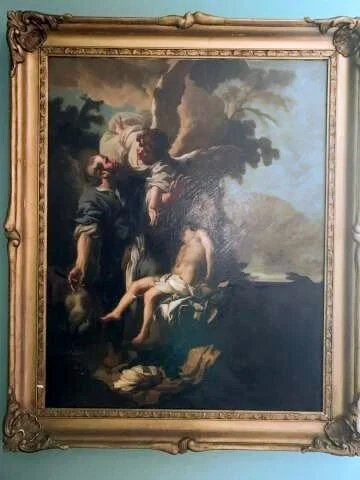
‘Sacrifice of Isaac’ Johan Liss (1625-26)
The artist gets it.
This story feels dark. It is full of tension and passion and discomfort. In fact, when the Bishop came into my office before our Celebration of New Ministry service, she looked at it and said rather matter-of-factly, “You can remove that painting, you know.”
Of course, I knew I could, but I never would. For some reason this story speaks to me. It unsettles me. It draws me in. It refuses easy answers. Perhaps that is because difficult stories are often the ones that still have something to teach us. So today, I want to focus not on the Gospel but on this account from Genesis because I think we often misunderstand what is happening here.
One phrase appears three times: “Here I am.”
Abraham says it to God. Then to Isaac. Then to the angel. Three times Abraham responds—not with explanation, certainty, or control—but with presence. Here I am.
Maybe that is the key. For generations people have called this the story of Abraham being tested, and certainly the text opens that way, but I wonder if when we hear the word “test,” we hear something the text itself does not intend.
To us, a test sounds like pass or fail. A test sounds like God setting a trap or Abraham proving something but the Hebrew word used here is richer than that.
The word is nissah. While it is often translated as “tested,” it can also mean to prove, to refine, to reveal, to bring something into lived reality. Not testing in the sense of discovering information. Testing in the sense of revealing what is already there. Like metal refined in fire—not to discover whether it is metal, but to reveal its true nature.
That changes the story because maybe God is not trying to discover whether Abraham trusts. Maybe Abraham is being invited to discover the depth of his own trust. This story is not about Abraham proving something to God. God already knows Abraham. God already loves Abraham. This is about relationship becoming real. Not whether Abraham believes in God, but whether Abraham trusts God enough to place everything—even the promise itself—back into God’s hands.
Because Isaac is not simply Abraham’s son. Isaac is the promise. The hope. The future. The impossible miracle given to Abraham and Sarah after they thought that season of life had passed.
Isaac is legacy. Isaac is identity. Isaac is everything.
Which raises a difficult question: Did Abraham ever really possess Isaac? Or did Abraham understand something difficult and holy—that Isaac was always a gift?
Gifts are not possessions. They are entrusted to us. There is an important spiritual question here: What in your life have you started calling “mine” that was always God’s?
My children. My plans. My reputation. My church. My time. My future.
Perhaps discipleship is learning to hold everything with open hands.
That does not make this story easier. Abraham still climbs the mountain. Isaac still asks: “Father… where is the lamb?” And Abraham responds: “God himself will provide.” Notice Abraham does not say: I understand. He does not say: I approve. He says: God will provide.
Even walking into mystery, Abraham trusts that God remains faithful. And then comes the ram. That ram matters. That hard-to-see ram in the corner of the painting is the whole point. The ram changes everything because God interrupts sacrifice. God provides. The story never ends with Isaac’s death. The mountain receives a new name: “The Lord will provide.”
That mattered in the ancient world because people often imagined their relationship with the gods was transactional. You sacrifice to get what you want. This story turns that upside down. Our relationship with God is not transactional. God is not interested in extraction. God is interested in trust.
And that brings us into Romans when Paul says: “Present yourselves to God.” Notice he does not say destroy yourselves. He says offer yourselves. Christian sacrifice is not annihilation. It is surrender. Making ourselves available to God.
Then Matthew brings all of this back down to earth. Whoever welcomes you welcomes me. Whoever gives even a cup of cold water…
Suddenly holiness looks ordinary. Hospitality. Presence. Receiving. Maybe this is what “Here I am” looks like most of the time. Not climbing mountains, but showing up for God, for our neighbour, for one another.
Perhaps there is something timely here in this season where many mark Pride Month because underneath all of the celebration and conversation is a deeper question: Who gets to tell us who we are?
Genesis reminds us that people are not possessions. Not even our children. Not even ourselves. Isaac belonged first to God and there is something freeing in remembering that every person belongs first to God—before labels, before expectations, before fear. We belong to the God who creates us, calls us, and names us beloved.
Perhaps Pride Month invites us to ask whether our communities are places where people can stand honestly before God, and one another, and say: “Here I am.” Not because identity is the centre of the Gospel, but because relationship is.
The God who calls Abraham, the God Paul tells us to offer ourselves to, and the Christ who says whoever welcomes another welcomes me, is always drawing people into deeper trust and deeper belonging. That means the Church’s work is not ownership. It is hospitality.
The invitation of faith is not to possess one another—but simply to answer, again and again, the call of God with Abraham’s words: Here I am.
Here I am with my fears, with my family, with my future, with what I have been holding too tightly.
Perhaps we discover, as Abraham did that this was never about being tested, t was always about learning to trust. Trust that what God promises, God provides. Trust that what God gives, God does not abandon. Trust that when we finally open our hands—God is already there.
Amen.