
Sunday Sermon - 11 October
Last Monday, I was having lunch with a really good friend and former boss of mine. He had recently been in a very serious car crash. A car came straight at him on the highway, going the wrong way. He was hit head on and his car was destroyed. The other driver died in the crash. Somehow, my friend came away relatively unscathed, with just a knee injury, a concussion, and some soft-tissue soreness.
We started talking about how fortunate he was to survive and to not be more seriously injured, and that led us into some pretty existential questions about life and how infinitesimally small the chances are that any of us would even exist in the first place.
(you know the usual light, lunch banter!)
We ended up talking, not just about how extraordinarily fortunate he was but, in fact, how fortunate we all are – simply to have been born where and when we were born.
Let’s think about that for a moment.
Neither of us did anything to earn being born in Canada. We didn't choose our parents. We didn't choose our birthplace. We didn't choose the circumstances into which we were born. We could have been born in desperate places, like Burundi, The Central African Republic or South Sudan (which are currently ranked as the top three most impoverished countries in the world according to the IMF’s World Economic Outlook Data) or any number of places in the world where life can be unimaginably difficult. Instead, we were born here. In Canada. At this particular moment in history.
With that comes an extraordinary number of opportunities and privileges. The strange thing is that, in a very real sense, it was just chance. We didn't do anything to deserve it. We just happened to be born here. Our spirits just happened to have animated our bodies, here.
I have been thinking about that conversation with my friend ever since we met up. For me it has an important relevance for us on Thanksgiving because Thanksgiving is fundamentally about recognizing a gift.
The Israelites in our reading from Exodus have just been given an extraordinary gift. They have been liberated from slavery in Egypt. They have crossed the Red Sea. They have experienced God's presence and protection. Then Moses goes up the mountain—and stays there for quite some time. Eventually the people become impatient.
They turn to Aaron and say, essentially, “Give us something we can see. Give us something tangible that we can hold on to.” Aaron takes their gold jewellery and makes them a golden calf. They begin worshipping this golden calf and saying, “These are your gods, O Israel, who brought you up out of the land of Egypt!” They have taken the gold they already have—and turned it into the thing they worship. They have taken a possession and turned it into a god.
You know, I think that this is one of the greatest temptations of human beings. We receive something good, something beautiful, something that has been given to us, or maybe we’ve even worked hard to get, and slowly (almost without noticing) we begin to give it divine value and a sacred identity. Forgetting where the source of all gifts come from and what is really sacred in our lives. Sadly, we have a tendency to worship the gift instead of the Great Giver of All Gifts.
This is where the golden calf becomes a very good Thanksgiving metaphor. The question for us is not whether we have blessings. We do. The question is: What do we do with them? What happens when we start believing that everything we have is simply the result of our own hard work? We put the things up on that sacred pedestal. Yes, some of the things we have we’ve worked hard for, but not all of it. In fact, there is some inherent privilege, that we simply find ourselves born into, that provides us with the opportunity ‘to earn’ in the first place.
None of us built the world into which we were born. None of us chose the country into which we were born. None of us created the opportunities that happened to be available to us. None of us created the gift of life itself.
Now, this doesn't diminish our accomplishments. I am simply trying to put them into perspective. We are not entirely self-made. We are, in so many ways, ‘gift-made.’
My point is this - Thanksgiving is more than simply about being grateful and saying “thank you.” The real response to being blessed with food security, shelter, a certain measure of wealth, and all the ‘nice things’ we enjoy isn’t mere gratitude (though gratitude is important). Saying Thank You to gift-givers and God is important, but the real response to gratitude is generosity.
If I recognize that what I have is a gift, then I can't simply hold on to it as though it belongs to me. I have a responsibility to share it.
Paul says in Philippians, “Do not worry about anything, but in everything by prayer and supplication with thanksgiving let your requests be made known to God.” And then he says, “Rejoice in the Lord always.” Paul isn't saying that everything is perfect. It wasn't. He knew hardship and uncertainty and imprisonment. What Paul is saying is that gratitude is a way of seeing.
It is the ability to look at our lives and recognize what we have received and then respond. Respond with generosity.
I saw this reel on Instagram the other day. It had this guy in a mall, or somewhere like that, with a pie and he was asking people to guess how much pie would be divvied up between the wealthy, the middle class and the lower-income or poorer class. Since it’s Thanksgiving it's a perfect illustration for today. Imagine that all of the wealth in Canada could be represented by one pumpkin (my favourite) pie.
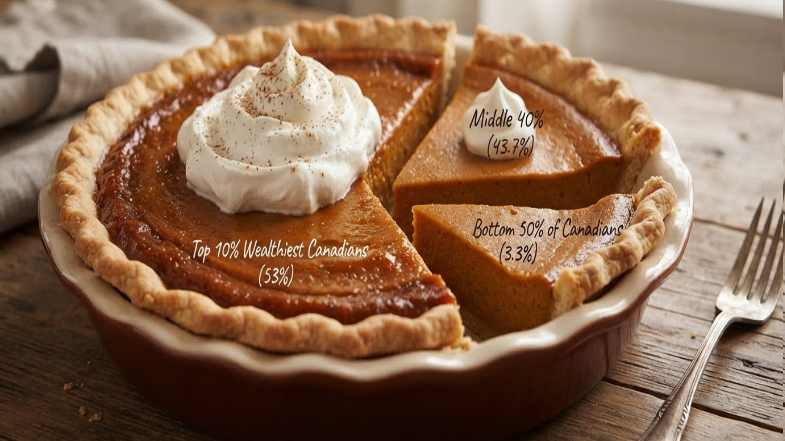
According to the 2026 World Inequality Report.
Top 10% — only about 4.2 million Canadians own 60.4% of Canada's wealth — so they get more than 2 and ¼ quarters or well over half of the pie.
Middle 40% — about 16.7 million Canadians get 25.7% — just over 1 quarter of the pie.
Bottom 50% — so half of our entire population – about 20.9 million Canadians - the largest group of Canadians by far, share just over half of a quarter - an 1/8th of the pie. 13.8% of all of Canada’s wealth has to be shared by 20.9 million people.
Those numbers are big and how we define wealth is complicated, but just imagine that pie sitting on the table. Imagine half of the people in Canada standing around it while a few people eat most of it and, when they’re done, the rest, the majority of the people standing there, who just watched a few people gorge away, only get a couple of bites. I don’t know about you, but that makes me kind of uncomfortable. Not because we should feel guilty for having blessings but because blessing carries responsibility. You see, it isn't whether we are allowed to enjoy our slice of the pie. Of course we are. But the point is, when we begin to believe that the pie was made exclusively for us, that it is our pie and they should just be thankful we are sharing at all, we are totally misguided. That, my friends, is the golden calf.
When something that we are blessed with becomes something we believe we must possess, protect, hoard and in some ways even worship, we are just as lost as those idol-worshipping Israelites.
In today’s Gospel, Jesus tells the story of a wedding banquet. The invitation goes out, the banquet is ready, and yet those who were invited decline. They have other things to do. Other priorities. They are so caught up in their own lives that they miss the gift being offered to them. So the invitation goes out to others—to those on the margins, those who might never have expected a place at the table. They are welcomed in, while those who assumed they had better things to do miss the banquet altogether.
I would be remiss if I didn’t at least touch on the rather uncomfortable ending about the guest who arrives without a wedding robe. The banishment seems harsh, especially after everyone has been invited in from the streets. Perhaps it reminds us that an invitation is about more than simply showing up. We are called to respond to the gift we have been given, to humbly appreciate the invitation and to abide with the expectations and responsibility accordingly.
Today, I believe that is what the point of the wedding robe is meant to remind us of: that accepting God’s invitation involves more than simply showing up. The gift of life, and Christ’s love that we have received, is meant to change us. It is meant to shape how we live and how we respond to the world around us.
Today’s readings are like a gentle warning for us this Thanksgiving. You see, we can become so comfortable with our blessings, so preoccupied with what we have and what we want, that we forget they are gifts in the first place. We can miss the point entirely, and either decline God’s invitation or take it for granted. The gift is not simply ours to enjoy; it is an invitation to live with gratitude, and to respond with generosity, to share what we have with others.
Now, I’m not simply talking about giving money to the church, or food to the food bank, or whatever donation to whatever cause. It is recognizing that our lives, our resources, our relationships, our communities, and this beautiful earth itself have been entrusted to us—as we’ve talked about these last weeks throughout the Season of Creation. Our lives, our resources, everything we have, whether we’ve worked for them or not, is gift - an invitation to a wonderfully blessed life.
Our task is to accept the gifts and use them carefully and for good purpose. So this Thanksgiving, let us absolutely give thanks. Give thanks for the food. Give thanks for family and friends. Give thanks for this beautiful country. Give thanks for the opportunities we have been given. Give thanks for the privilege of life, of living, of being here together.
Then, I ask you to take another step, a step beyond gratitude. Let our gratitude become generosity. The true measure of Thanksgiving isn't simply stating how grateful we feel. It is what our gratitude urges us to do. To open our hands. To make us more generous. To make us more attentive to those who have less pie than we enjoy.
I pray, then, that we will not turn our blessings into golden calves, but rather remember just how much we have been given—including the extraordinary and fragile gift of life itself.
As we enjoy this feast of life that has been placed before us, let us give thanks for the gift of being here, at this time and in this place. Then let that gratitude move us beyond ourselves—to remember and invite those who are still waiting for a place at the table, and to become a people who share the abundance we have been given.
Life is gift. What we have is gift. The response to gift is gratitude. The response to gratitude is generosity.
I wish you all a blessed and Happy Thanksgiving.
Amen.